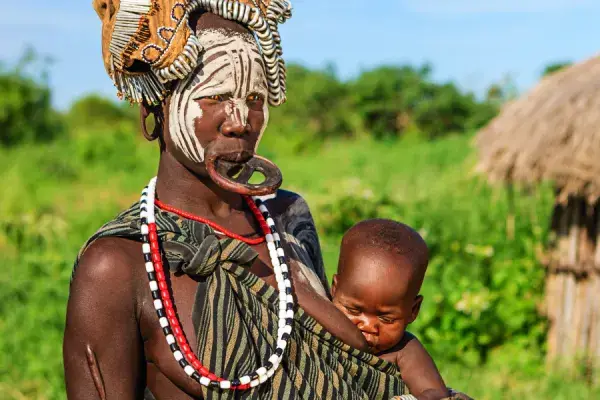

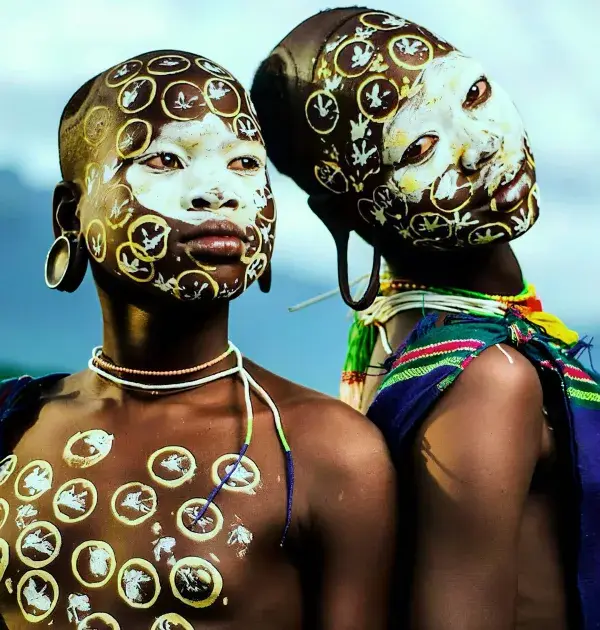
The Omo River winding through the Lower Omo Valley at golden hour — home to many of Ethiopia's ancient tribes
Ancient communities of the Omo Valley

A Look Into the Tribes of Ethiopia

Cultural traditions, ceremonies and the everyday lives of 11 of Ethiopia's most fascinating ancient communities.

Ethiopia — often called the cradle of humanity — is a treasure trove of cultural traditions and one of the oldest inhabited countries in the world, with human activity stretching back millions of years.

Tribes have shaped the Ethiopian landscape for centuries, developing tools, rituals and ways of life perfectly adapted to challenging surroundings. Deep in the Omo Valley these traditions still come alive each day — colourful backdrops, tribal ceremonies and some of the most striking art forms anywhere on the continent.

Below we introduce 11 of Ethiopia's most fascinating tribes — their practices, their craftsmanship and a few surprising fun facts along the way.

Ari Tribe — Highland farmers near Jinka with the largest community in the Omo Valley.
Tribe 01

Ari Tribe

Highland farmers near Jinka with the largest community in the Omo Valley.

Region
Highlands around Jinka, Omo Valley
Population
~120,000
Language
Aari (Omotic, nine dialects)

The Ari tribe are known for their agricultural practices and vibrant cultural expressions. With roughly 120,000 people, they are the largest community in the Omo Valley.

The Ari are organised into nine sub-tribes, each governed by a spiritual leader called the Babi, supported by his assistant the Godmi. Religion is central to daily life, with frequent ceremonies and rituals.

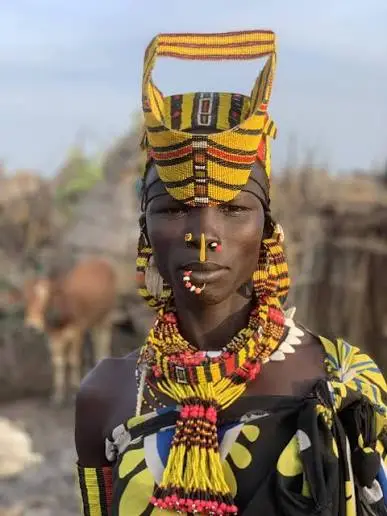
They cultivate crops like maize and sorghum, and their traditional attire features intricate beadwork and beautiful patterns that showcase the artistry of the tribe.

Did you know? Ari men often wear striking hats adorned with colourful beads during ceremonies.
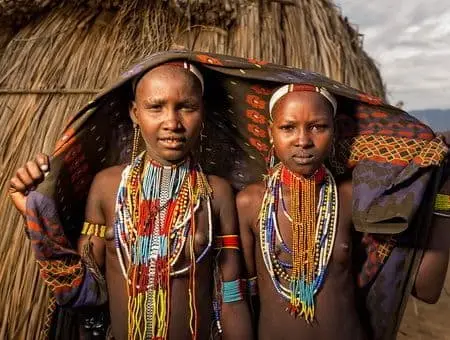
Arbore Tribe — A small semi-nomadic community by Lake Chew Bahir with deep cultural identity.
Tribe 02

Arbore Tribe

A small semi-nomadic community by Lake Chew Bahir with deep cultural identity.

Region
Near Lake Chew Bahir (four villages)
Population
~6,850
Language
Arbore

The Arbore live in four villages — Gandareb, Kulaama, Murale and Eegude — which become harder to reach in the rainy season, leaving the community more isolated than most.

They share ancestral links with the Konso and similarities with the Dassanech. While close to the Hamer, they live largely in harmony with neighbouring tribes.

Semi-nomadic by nature, they rely on cattle herding and fishing. Children have shaved heads; unmarried women drape a black cloth over their head; once married they wear shoulder-length braids to signify their status.

Did you know? The end of the rainy season is celebrated with lively festivals of dance, song and clay and chalk body painting.
Banna Tribe — World-famous stilt walkers of the Omo Valley.
Tribe 03

Banna Tribe

World-famous stilt walkers of the Omo Valley.

Region
South Omo, southwestern Ethiopia
Population
~45,000
Language
Hamer-Banna (Omotic)

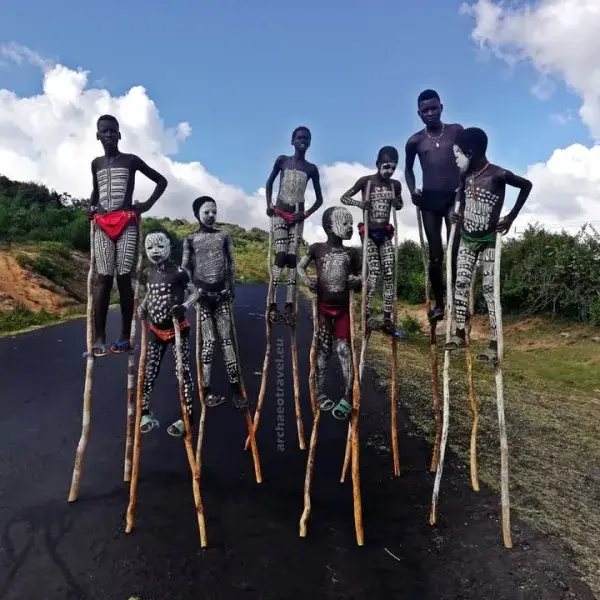
The Banna (or Benna) are best known for their stilt walking. The towering wooden Tewa were originally used to avoid dangerous animals and cross marshlands, but today they are a vibrant feature of weddings and ceremonies.

Agricultural by tradition, the Banna celebrate major events with dancing, singing and body painting using white chalk mixed with red iron ore, charcoal and yellow rock.

Elaborate beaded hairstyles for women can take hours to create, and the tribe even has its own king — a living expression of their proud cultural identity.

Did you know? Stilts called 'Tewa' began as practical tools and evolved into a defining cultural symbol of the Banna.
Bench Tribe — Skilled highland farmers and weavers of southwestern Ethiopia.
Tribe 04

Bench Tribe

Skilled highland farmers and weavers of southwestern Ethiopia.

Region
Southwestern Ethiopia
Population
~547,000
Language
Bench (Omotic)

The Bench, also known as Gimira, live in the southwestern highlands and are renowned for cultivating maize, sorghum and teff. Their finely woven baskets and pottery are an important part of their cultural heritage.

Found only in Ethiopia, the Bench community of around 547,000 people predominantly follows Eastern Orthodox Christianity, blending faith with deep agricultural traditions.

Did you know? Their basketry and pottery often draw motifs from the crops they cultivate.
Dassanech Tribe — Nomadic riverbank people with clan-based ritual life.
Tribe 05

Dassanech Tribe

Nomadic riverbank people with clan-based ritual life.

Region
Banks of the Omo River (Lower Omo Valley)
Population
~60,000
Language
Dassanech (East Cushitic)

The Dassanech, also called Daasanech, are organised into eight co-residential territorial groups that perform many rituals together. Their semi-circular huts, built by women, are designed for ventilation and security in a nomadic life.

Membership in the tribe is based on a shared circumcision ritual rather than ethnicity. Clans hold specific powers — the Galbur clan, for example, is believed to control water and crocodiles.

The Dimi ceremony is a major rite of passage, celebrating a daughter's fertility and future marriage with feasting and dancing during the dry season to ensure food security.

Did you know? Beaded headdresses are sometimes assembled from recycled materials such as bottle caps and watch parts.
Dizi Tribe — Highland cultivators of the Maji area with a unique friendship ritual.
Tribe 06

Dizi Tribe

Highland cultivators of the Maji area with a unique friendship ritual.

Region
Maji woreda, southwestern Ethiopia
Population
~36,000
Language
Dizin

The Dizi are a small ethnic group of highland cultivators. Once far more numerous, oppressive colonial-era policies reduced their population dramatically, with only about 20,000 remaining in the 1970s.

Today the Dizi are recognised by their colourful patterned clothing and a strong agricultural lifestyle that reflects centuries of highland adaptation.

Did you know? The 'Naali' ritual binds two people of the same sex into quasi-relatives by tapping shoulders with goat hide and drinking from a shared kofu cup.
Dorze Tribe — Master weavers living in striking beehive-shaped homes.
Tribe 07

Dorze Tribe

Master weavers living in striking beehive-shaped homes.

Region
Gamo Highlands near Chencha and Arba Minch
Population
~30,000
Language
Dorze (Omotic)

Historically the Dorze were known as fierce warriors; today they are primarily farmers and weavers, producing some of Ethiopia's most recognised cotton textiles.

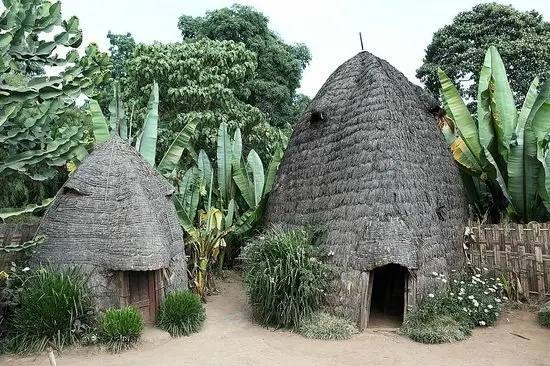
Their beehive-shaped huts, made from bamboo and woven plant fibres, can last more than 50 years when well maintained — a remarkable feat of vernacular architecture.

Did you know? Dorze huts are sometimes 'walked' to a new spot by a group of villagers when the base needs replacing.
Hamer Tribe — Cattle people of South Omo, famed for the bull-jumping rite.
Tribe 08

Hamer Tribe

Cattle people of South Omo, famed for the bull-jumping rite.

Region
South Omo, southwestern Ethiopia
Population
~50,000
Language
Hamer (Omotic)

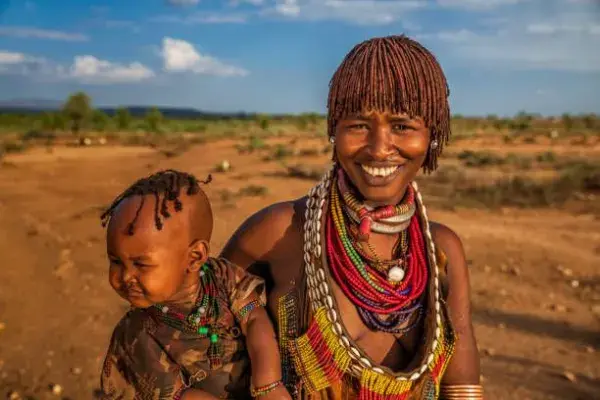
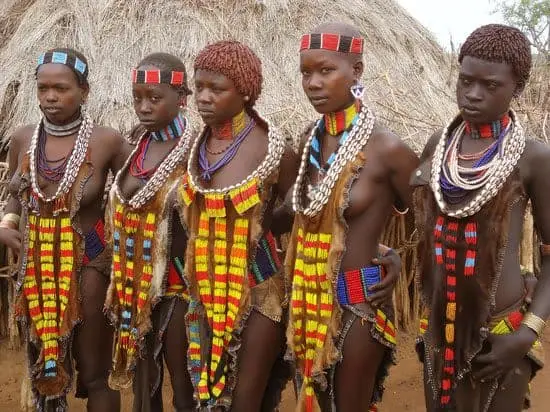
The Hamer are a colourful Omotic community known for distinctive body adornments and a deep love for cattle. Women wear heavy iron jewellery and braid their hair with ochre.

The bull-jumping ceremony marks a young man's transition to adulthood — a test of bravery alongside music, dance and feasting that brings the whole community together.

While the Hamer have embraced some elements of Islam, they continue to honour their ancestral beliefs and traditions.

Did you know? Hamer women's ochre-coated braids are made with a mixture of butter, water and red clay.
Kara (Karo) Tribe — Renowned body artists of the Omo River.
Tribe 09

Kara (Karo) Tribe

Renowned body artists of the Omo River.

Region
Banks of the Omo River
Population
~1,500
Language
Kara (Omotic)

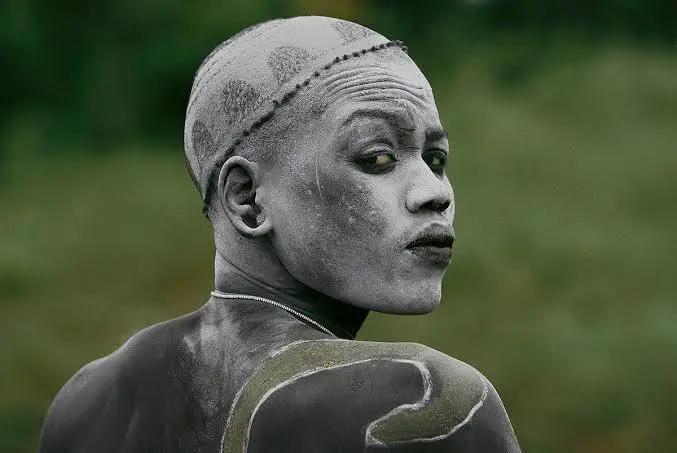
The Kara, or Karo, are one of the smallest tribes in the Omo Valley yet among the most visually expressive. Both men and women paint their bodies with white chalk and coloured minerals in patterns often inspired by animals.

Beyond art, they practise agriculture along the Omo River and use unique fishing techniques that have sustained them for generations.

Strong community ties, oral history and a degree of geographic isolation have helped the Kara preserve their traditions in a rapidly changing world.

Did you know? The chalk used in Kara body painting is sourced directly from local riverbeds.
Konso Tribe — Cushitic farmers behind a UNESCO-listed cultural landscape.
Tribe 10

Konso Tribe

Cushitic farmers behind a UNESCO-listed cultural landscape.

Region
Konso highlands, southern Ethiopia
Population
~250,000
Language
Konso (Cushitic)

The Konso live in walled towns governed by councils of elders, with a strict social hierarchy based on generation grades. Their dry-stone terraces and walled villages form a UNESCO-listed cultural landscape.

Their economy depends on intensive agriculture — irrigation, terracing and the cultivation of maize, sorghum, cotton and coffee — supported by cattle kept in stalls and fed on the by-products of farming.

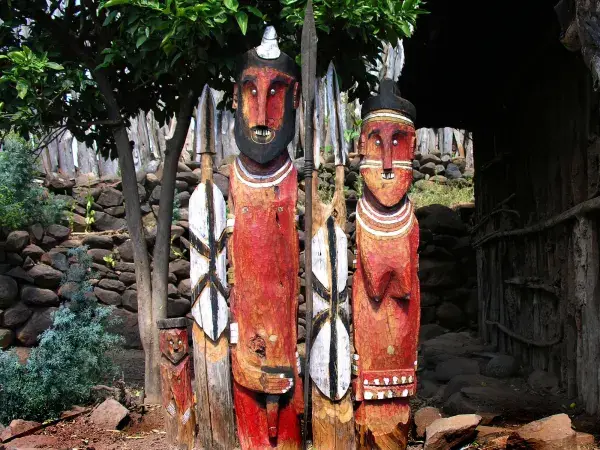
Did you know? 'Waka' are carved wooden grave markers raised to honour respected ancestors and warriors.
Mursi Tribe — Omo Valley pastoralists known for the iconic clay lip plate.
Tribe 11

Mursi Tribe

Omo Valley pastoralists known for the iconic clay lip plate.

Region
Omo Valley, southwestern Ethiopia
Population
~10,000
Language
Mursi (Nilo-Saharan)

The Mursi are an Omotic-speaking people of the Omo Valley. Women are widely recognised for the large circular clay lip plates inserted at a young age and gradually stretched — a long-standing marker of beauty and maturity.

Their life revolves around cattle herding, agriculture and a complex social structure, with elaborate hairstyles and body adornments to match.

Despite the pressures of modern life and the surrounding Omo National Park, the Mursi continue to maintain their distinct way of life.

Did you know? Mursi men compete in ceremonial stick-fighting matches known as 'donga' to win prestige and the favour of potential brides.

Meet the tribes of Ethiopia in person

Travel with expert local guides through the Omo Valley and experience these living cultures with respect, depth and warmth.

Plan trip